«L’Espresso», 3 febbraio 1957
Carmelitane in due dimensioni
Nello schieramento artistico del primo dopoguerra,
Poulenc apparteneva alle forze della così detta musica moderna. Nulla di strano
per un musicista che era fra gli elementi più in vista del Gruppo dei Sei,
tenuto a battesimo da Jean Cocteau e mirante a spingere la musica francese
sulla via dell'antiromanticismo, segnata da Debussy e da Ravel. Ma lo strano è
che quella posizione Poulenc l'occupava praticando un linguaggio musicale tutto
nutrito di ricordi ottocenteschi. A differenza di Milhaud e di Honegger, egli
non sentiva il dovere di farsi un linguaggio originale: quel dovere che, coi
termini moralistici oggi in uso, vien definito come quello d'una presa di
coscienza dei problemi della musica contemporanea.
Dei problemi della musica contemporanea Poulenc se ne
infischiava. Era pieno di affetto e di gratitudine per i maestri del passato (e
per qualcuno dei contemporanei, come Debussy, Ravel e Strawinsky), e si serviva
del loro esempio con un'improntitudine ch'era la sua forza e la sua grazia. Era
diventato un maestro della citazione spiritosa, gettata là con un ammiccar
d'occhi, come in una conversazione tra persone coltissime, che se si servono di
parole di Proust, o di Joyce, o di Gide, o di Thomas Mann, non lo fanno per
accademica erudizione né perché a loro manchino parole proprie, ma perché
citando proprio quelle vogliono evocare immediatamente nell'ascoltatore
avvertito tutto quel nodo di valori storici, ambientali e di costume che è
connesso all'accezione proustiana, joyciana, ecc. delle parole stesse. Se si
serviva di modi musicali tipici di Debussy, o magari di Massenet, non per
questo era un loro epigono, che si servisse di quel linguaggio per esserci nato
e cresciuto dentro, senza conoscerne altro. Le sue erano, appunto, citazioni.
Poulenc componeva così una musica dove i valori del gusto
sopravanzavano quelli più propriamente creativi, e che poteva parere
incantevole, oppure irritante, a seconda che gli ascoltatori fossero dotati o
privi, per l'appunto, di gusto e di senso dello humour.. I balletti Les biches,
Aubade e Les animaux modèles, il Concerto campestre e quello per due
pianoforti, la cantata Le bal masqué, alcune pagine pianistiche e molte vocali
sono piccoli capolavori di libertinaggio musicale.
L'apparenza scherzosa impedì a Poulenc di essere preso
sul serio quanto Honegger e Milhaud (mentre era forse, fra i «Sei», la natura
musicale più autentica e dotata). Ma ei voleva poco a sentire che sotto c'era
un sentimentalismo quasi gozzaniano, e che quelle citazioni buffonesche
tremavano d'affetto per la musica in sé e per i suoi grandi. Ad ogni modo venne
un momento in cui Poulenc volle smettere di buffoneggiare: senza abbandonare il
semplice impianto della sua scrittura di finto ingenuo, cercò di dire i
pensieri gravi che l'età matura e l'oscurarsi dell'orizzonte europeo gli
suggerivano. Scrisse molte composizioni corali sacre, a cappella, che stupirono
assai e vennero considerate con rispetto, ma della cui reale riuscita è lecito
dubitare. Poi in memoria di García Lorca scrisse una Sonata per piano e violino
che rinnova, su un piano di serietà patetica, il consueto gioco di prestigio
d'un'opera d'arte scritta in un linguaggio di cinquant'anni fa, ma trattata con
sensibilità e intelligenza moderne.
Sugli interessi del capitale tematico investito in questa
commovente Sonata Poulenc ha vivacchiato per quasi vent'anni, citando se stesso
alla pari con Ravel, Fauré, Strawinsky e compagni. Bisogna dargli atto che ora,
accingendosi alla grande impresa di musicare, quasi intatto, il testo dei
Dialoghi delle Carmelitane di Bernanos, egli ha, per la seconda volta in vita
sua, rifatto il proprio guardaroba musicale, e se vive molto spesso all'ombra
del melodismo vocale di Musorgskij, non saccheggia mai la propria Sonata per
violino.
Ma con che cosa ha potuto sostituire quel patrimonio,
sfruttato fino all'ultimo centesimo? In un'epoca come la nostra, dove, per
varie che siano le tendenze e le mode musicali, un punto almeno è pacifico, ed
è il rifiorire della profondità di prospettiva polifonica, Poulenc è forse
l'ultimo musicista che assapori con voluttà la disposizione verticale dei suoni
nell'accordo. Con la sua indifferenza ai problemi del linguaggio musicale
contemporaneo, egli si è chiuso in una musica che conosce soltanto due dimensioni:
quella della melodia e quella dell'accompagnamento.
È vero che nell'ottocento si sono scritte fior di opere
liriche con queste due sole dimensioni della musica. Ma con certe invenzioni
melodiche che oggi son più rare d'una quaterna secca. Poulenc è un uomo del
nostro secolo, pieno di sobrietà e di ritegno: la sua musica è tutta
genericamente melodiosa, ma non dona grandi melodie. Forse, anche se gli
venissero, Poulenc non le pronuncerebbe, per motivi di gusto e di educazione.
Suggerisce spunti melodici, e li tiene a galla, come un turacciolo, sugli alti e
bassi di accompagnamenti metodici e tradizionali: i bassi in battere e un
accordo relativo in levare. Che in parole povere vuol dire: «umpa, umpa».
« Venne un momento in cui Poulenc volle
smettere di buffoneggiare: senza abbandonare il semplice impianto della sua
scrittura di finto ingenio, cercò di dire i pensieri gravi che l'età matura gli
suggeriva. Figurini per i Dialoghi delle Carmelitane, di Georges Wakhévitch.
Per il testo di Bernanos, intessuto di sottigliezze
psicologiche (e qualche volta soltanto verbali), queste due risorse d'una
melodia pudica e d'un accompagnamento tradizionale sono davvero un po' poco. Il
compositore le adopera con raffinatezza squisita, e alcuni dei 16 episodi
musicali che compongono l'opera presentano quelle grazie di oreficeria, quel
miniaturismo che è del migliore Poulenc: particolarmente nel grosso nucleo
omogeneo che sta a cavallo del primo e del second'atto (malattia e morte della
Superiora, veglia funebre, legame affettivo che si forma tra l'orgogliosa e
complicata Suor Bianca e la semplice Costanza). Qui la musica coglie davvero
ciò che nel soggetto più corrispondeva alle doti naturali dell'arte di Poulenc:
il vario profumo di femminilità che vapora sotto l'umiltà monacale. Ma la
musica si arresta gelata e gira al largo di fronte a giansenistiche
sottigliezze verbali come: «Che giova ad una religiosa essere staccata da
tutto, quando non si è distaccata da se stessa, cioè dal suo proprio
distacco?».
Una volta esaurita la fertilità di due motivi conduttori
che sembrano adombrare i due aspetti dell'ordine carmelitano, umiltà e coraggio
cavalleresco, la monotonia degli accompagnamenti e il fastidio del perenne
ritmo binario fanno presto a prevalere sulla generica melodiosità della
declamazione. D'accordo, è la natura del soggetto che richiede questo tipo di
musica a mezze tinte: soggetto così particolare («Figliola», dice la Superiora
a Suor Bianca, «la buona gente si domanda a che cosa serviamo, e in fondo non
ha poi tutti i torti... Solo la preghiera giustifica la nostra esistenza, e chi
non crede alla preghiera non può considerarci che delle impostore e dei
parassiti»). Tuttavia è lecito ricordare che Erik Satie, musicando lunghi passi
di Dialoghi platonici, aveva realizzato una musica di questo tipo, certo, ma
più capace di serrare da presso il noeciolo ideale di quel pensiero. Qui
abbiamo una diligente illustrazione analitica dei fatti e dell'ambiente (più
che dei caratteri): ma la paura, che è il vero argomento in questa storia di
monache militanti, nella musica non c'è.
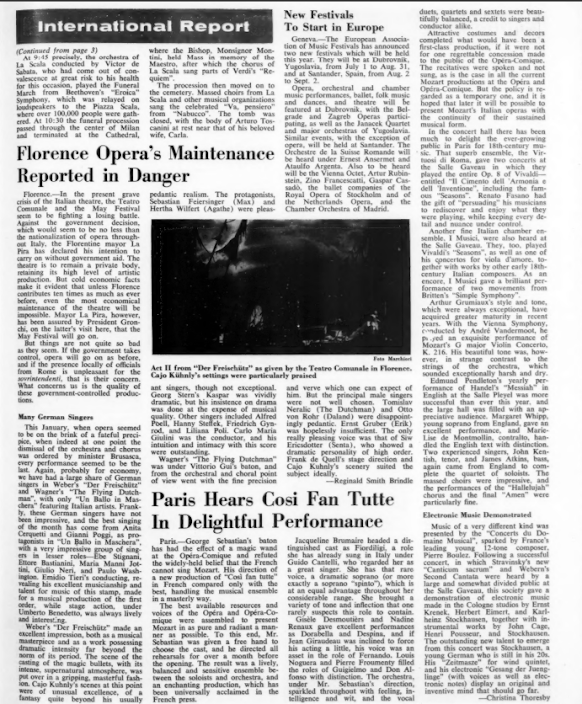
THE NEW GROVE BOOK OF OPERA
1996
STANLEY SADIE
Dialogues des
Carmélites (Dialogues of the Carmelites)
Opera in three
acts by Francis Poulenc to his own libretto after Georges Bernanos' play;
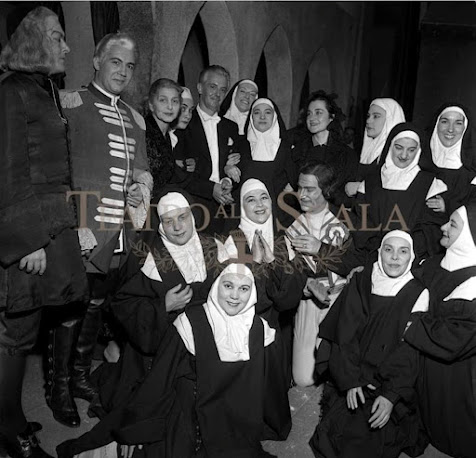
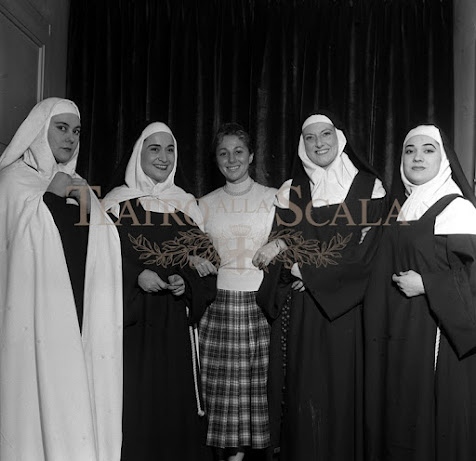
Milan, Teatro alla Scala, 26 January 1957.
The cast at
the première included Virginia Zeani (Blanche), Leyla Gencer (the new
Prioress), Eugenia Ratti (Constance) and Fiorenza Cossotto (in the small part
of Mathilde), the conductor was Nino Sanzogno. At the Paris premier the singers
were Denise Duval (Blanche), Régine Crespin (the new Prioress), Rita Gorr
(Mother Marie) and Liliane Berton (Constance); Pierre Dervaux was the
conductor.
The Marquis de
la Force baritone
Blanche de la
Force his daughter soprano
The Chevalier
de la Force his son tenor
Madame de
Croissy Prioress contralto
Madame Lidoine
the new Prioress soprano
Mother Marie
of the Incarnation assistant Prioress mezzo-soprano
Sister
Constance of St Denis a young nun soprano
Mother Jeanne
of the Child Jesus dean of the community contralto
Sister Mathilde
old nun mezzo-soprano
Mother Gerald
Sister Claire
Sister Antoine
(Portress)
Sister
Catherine
Sister
Felicity
Sister
Gertrude
Sister Alice
Sister
Valentine
Sister Anne of
the Cross
Sister Martha
Sister St
Charles
Father
Confessor of the Convent high baritone
First Officer tenor
Second Officer
baritone
Gaoler baritone
Thierry a valet
baritone
M. Javelinot a
physician baritone
Officials of
the municipality, officers, police, prisoners, guards
Setting
Chiefly the Carmelite convent at Compiègne, later Paris during the French
Revolution and subsequent Terror, 1789-94
The story of
the Compiègne Carmelites was first told by one of their number, Mother Marie of
the Incarnation of God, who survived the Terror and lived until 1836. The
publication of her Relation led to the beatification of the nuns in 1906. In
1931 their story was turned into a novel by the German Catholic convert
Gertrude von Le Fort, the heroine Blanche was her invention. In 1947 the
Austrian priest and French resistance fighter Father Brückberger devised a
cinematic scenario on the subject and engaged the French novelist Georges
Bernanos to write the dialogue. Just as Gertrude von Le Fort had written
herself into her heroine (she named her 'de la Force"), so Beranos, then
suffering from terminal cancer, concentrated on the crisis of faith of the
dying Prioress (even giving her his precise age, 59) as well as exploring his
own religious obsessions. His work was deemed uncinematic, but it eventually
surfaced as a stage play, in which form Poulenc saw it in the early 1950s. When
the Ricordi publishing house suggested it as an opera Poulenc seized the chance
enthusiastically; but despite rapid composition (1953-6) the première was
postponed because of legal wrangles over the rights to the piece.
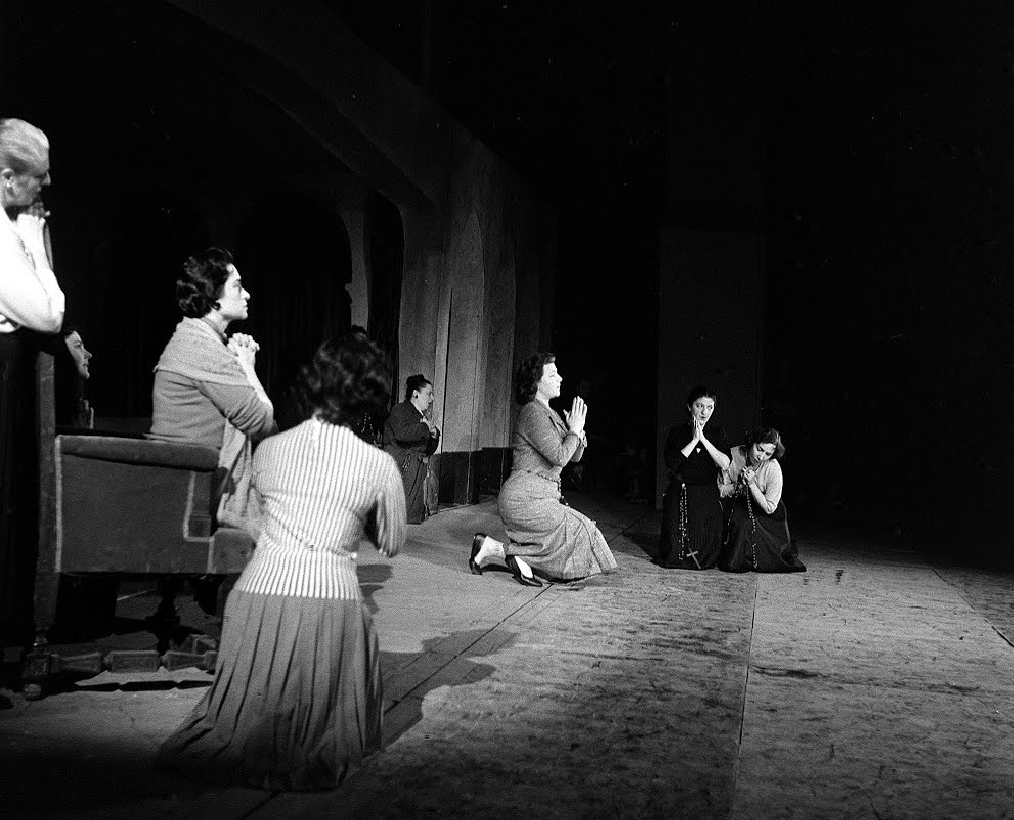
The opera was
first performed (in Italian) at La Scala in a production by Margherita
Wallmann. The Paris première was given a few months later (June 1957) with
Poulenc's intended cast; the producer was again Wallmann, and for reasons of
staging, extra orchestral interludes were composed for this production.
Performances at Cologne, San Francisco and on American television followed in
the same year. The first Covent Garden cast (1958) included Elsie Morison, Joan
Sutherland and Jeannette Sinclair with Rafael Kubelík conducting. Notable
recent productions include that of John Dexter, seen in America and Paris,
often with Crespin as the old Prioress, a role which she recreated in
Wallmann's 1983 production at Covent Garden with Felicity Lott (Blanche),
Pauline Tinsley (Mother Marie), Valerie Masterson (the new Prioress) and
Lillian Watson (Sister Constance).
Act I. The
library of the Marquis de la Force. The opera opens in a mood of
anxiety. The Chevalier de la Force voices his fears for his sister Blanche,
whom he knows to be nervous and easily frightened, for her carriage has been
held up by a protesting crowd. In a breathless Allegro, the Chevalier's father,
the Marquis, recalls the Royal Fireworks Panic he and his wife were caught up
in 19 years earlier, when his wife died giving birth to Blanche. Blanche
appears, seemingly composed: only the shifting unrelated harmonies of her music
betray her inner uncertainty. On her way to bed, she is terrified by a shadow
on the wall; she returns and with a mixture of resignation and resolution
expresses her resolve to take the veil and join the Carmelite order.
1.ii The
parlour of the Carmelite convent. Some weeks later the Prioress, seated because of
her age and infirmity, is interviewing Blanche. In a long flowing arioso
(underpinned by the anxious rising interval of a minor 3rd which permeates the
whole opera) she reminds her of the nature of their order. As the scene
continues the tone changes into rapid recitative (more violent minor 3rds in
the orchestra) as the interview becomes more like an interrogation to discover
Blanche's true motivation. The order can protect nobody; it is a house of
prayer which must be protected by its own members. The Prioress's music
switches rapidly from brusque accusatory outburst to lyrical and loving lines
when prayer is discussed. Blanche's resolve survives this ordeal and touches the Prioress,
who gives her blessing.
1.iii Inside
the convent. An austere plainsong ritornello leads to a surprising scherzo as we
meet young Sister Constance, Blanche's complete opposite. She is a peasant
girl, fun-loving and frothy, who can speak of life and death with the same
levity with which she treats the convent chores. She shocks and disarms Blanche
by admitting her premonition, her happy premonition, that she and Blanche will
both die young, and on the same day.
1.iv The
infirmary. A plangent
clamour of bells introduces the Prioress's death scene, one of the most
protracted, and realistic, in all opera. Over a steady ostinato rhythm, she
veers from visionary calm to delirium and agony-induced profanity: "who am
I to concern myself with God - let him first concern himself with me'. The
loyal and stolid Mother Marie is in attendance, chiefly concerned with avoiding
a scandal. The Prioress consigns Blanche, her youngest and thus most beloved
daughter, to Marie's particular care. Blanche appears twice - firstly to
receive a blessing, then, mysteriously unbidden, at the end of the tortuous
scene to witness the Prioress's last
undignified agony.
Act 2.i The
chapel. A simple and
moving requiem sung for the dead Prioress is interrupted by the jagged music of
terror. Blanche has been left alone to watch over the body and runs away in
panic. She is admonished and forgiven by the ever-watchful Marie. In an
interlude the music regains its calm as Constance voices her thought, central
to Bernanos theology, that perhaps we die not for ourselves but for others.
Perhaps we even die each other's deaths, so the Prioress's agony might afford a
poor sinner an easy passing: Perhaps the Lord God gave her the wrong death, as
a cloakroom attendant might give you the wrong coat.
2.ii The
chapter room. In the opera's most extended arioso the new Prioress warns the convent
of the adversity ahead. The simple harmonies and rhythmic implacability
underline her strength and humility. The scene closes with a moving Ave Maria.
Panic intrudes in a brief interlude in which a stranger is announced Blanche's
brother. Mother Marie allows the interview on the condition that she can be
present.
2.iii The
parlour. In an
extended duet, the nearest thing to a traditional love duet in the opera, the
Chevalier begs his sister to leave with him. As an aristocrat and a nun, she is
doubly in danger from the encroaching Terror. Poulenc's harmonic restraint is
loosened to produce music of Puccinian intensity as Blanche, by turns aloof,
agitated and affectionate, restates her desire to stay, to die if need be.
2.iv The
sacristy. The act ends
with a finale of Verdian dimensions. It opens with the Father Confessor leading
the sisters in the opera's third prayer, an intense and sensual Ave verum
corpus. He then bids them farewell; he has been forced to go into hiding. The
Prioress warns the sisters against easy pride, the temptation of martyrdom.
These are timely words as an angry crowd is heard followed by knocks at the
door. Commissars enter and read a decree of expulsion from the convent. Their
grotes queries is compounded when one of their number admits that he is
secretly sympathetic but in these dangerous times is forced to 'howl with the
pack' (collaboration was still a recent memory when this work was written).
Amid the general stupefaction Blanche is given a statue of the Infant Jesus. However,
a second wave of terrifying noise from the street causes her to drop the
statue, smashing it on the stone floor.
Act 3.i The
chapel. A stately
sarabande (Mother Marie's motif) bears witness to the sisters' strength in
adversity. The convent is devastated, desecrated. In the absence of the
Prioress, Mother Marie proposes that the sisters take the vow of martyrdom. To
ensure complete assent she suggests a secret vote. There is one dissenting
vote, Blanche's, thus rendering the decision invalid. Constance rushes forward
claiming the vote was hers, and that she has now reconsidered. The vote is
allowed to stand and Blanche, without the courage either to live or to die,
runs away. An interlude shows the nuns in numb disbelief as they hear their
community declared illegal in any form. In a lyrical codetta the Prioress
agrees to endorse the vow made in her absence. It was, after all, made to God.
3.ii The
library of the Marquis. We see and hear Blanche at her most tortured and
traumatized. Her father has been guillotined, his house ransacked. She is
living there as a servant. Mother Marie arrives; her music is a rock in
Blanche's sea of troubles. She tells Blanche that she may have saved her life
but not her soul. In a spoken interlude with ad libitum percussion set near the
Bastille, Blanche hears that the Compiègne Carmelites have been arrested.
3.iii The
conciergerie. In an arioso of ineffable calm the Prioress tries to fill her
imprisoned charges with strength and courage. The music is interrupted, becomes
frenzied and chattery as a gaoler enters and delivers their death sentence. The
Prioress concludes her interrupted aria with a loving, maternal blessing. An
interlude reveals Mother Marie at the height of anguish because she is not with
her condemned sisters. The Father Confessor calms her. If God has another
destiny for her, that is His will.
3.iv Place de la
Révolution. The final
prayer of the opera, the Salve regina, is sung to music of great lyrical
beauty. Over a rhythmic ostinato (again based on minor 3rds) the nuns' voices
rise and fuse as they sing their way to the scaffold. A crowd looks on,
murmuring and gasping as, one by one, the voices are silenced as the nuns are
guillotined. Blanche appears, now transfigured and fearless. Constance sees her
and walks to the scaffold; her face irradiated with joy. Blanche sings alone
until she too is guillotined. Dumbfounded, the crowd disperses.
This opera
among others of his late works consolidates the religious and musical
discoveries Poulenc made in the years 1936-40, when the untimely death of a
friend triggered a new maturity and he rediscovered his Catholic faith.
Although it displayed both technical and formal mastery, Poulenc used to
apologize for the unashamedly old-fashioned musical language of his opera. It
seems,' he wrote. 'That my Carmelites can only sing tonal music. You must
forgive them. He acknowledged his debt to the past in the work's dedication: to
Musorgsky, Monteverdi, Debussy and Verdi. He could have added Stravinsky, but
in a sense such a debt is reflected in most of his output. The carefully placed
and prosodically precise recitatives are redolent of Pelléas et Mélisande and
Popper; the epic sweep echoes that of Boris Godunov and Don Carlos. The
orchestration is extravagant (triple wind, two harps, piano- and guillotine)
but sparingly deployed, often in sections. The tessituras are equally carefully
planned: Poulenc's grand operatic models are Amneris (Mother Marie), Kundry
(old Prioress), Desdemona (new Prioress), Thais (Blanche) and Zerlina (Sister
Constance). The opera's musical language is further enriched by a series of
motifs which stand not only for various characters but also for the qualities
those characters embody, even when perceived in other people. Thus, when the
first Prioress tells Blanche to be steadfast, the orchestra seems to say,
"be just like Mother Marie'. When the second Prioress sings of her love
for the sisters we hear music used by Blanche when singing to her brother. This
sharing of musical material runs throughout the work and seems a felicitous
musical analogue for Bermanos' view of martyrdom: the transference of grace,
the universality of suffering. As Sister Constance says in the opera, perhaps
we do not die for ourselves, but for each other, or even instead of each other.
Who knows?"
KOBBE'S COMPLETE OPERA BOOK
1997
I DIALOGHI DELLA
CARMELITANA
Opera in three acts, libretto by Emmet Lavery from the drama by Georges
Bermanos, itself inspired by a novel of Gertrude von Le Fort and a scenario of
Rev. Fr. Bruckberger and Philippe Agostini. Première la Scala. Milan. 26
January 1957, with Virginia Zeani, Leyla Gencer, Gigliola Framoni. Eugenia
Ratti. Gianna Pederzini, conductor Nino Sanzogno. First performed at Paris
Opéra. 1957, with Denise Duval. Régine Crespin, Rita Gorr. Liliane Berton. Denise
Scharley, conductor André Cluytens: Cologne. 1957: San Francisco, 1957, with
Dorothy Kirsten. Leontyne Price, Blanche Thebom. Sylvia Stahlman. Claramae
Turner, conductor Leinsdorf: London. Covent Garden, 1958, in English with Elsie Morison,
Joan Sutherland. Sylvia Fisher. Jeanette Sinclair. Jean Watson, conductor
Kubelik: Vienna. 1959, with Seefried. Zadek. Goltz Rothenberger. Höngen,
conductor Hollreiser: Metropolitan. 1977. in English with Maria Ewing, Shirley
Verrett. Mignon Dunn, Betsy Norden, Régine Crespin, producer John Dexter.
Scala asked Poulenc for a new ballet score but were
told the composer was thinking of writing an opera, whose première they
immediately secured. Even though the genesis of Bernanos's Dialogues des
Carmélites is a story by a German writer and an idea for a film scenario by two
Frenchmen (it was only the dialogue for this film that Bernanos was asked to
supply). 'The psychology of fear which is the main theme of the Dialogues is
treated in a way entirely characteristic of Bernanos: and the same is true of
the interpretation offered in this play of the Communion of the Saints:
"One does not die alone:
one dies for others and even in the place of
others"." It is the great merit of Poulenc's setting of Bernanos's
Dialogues that he preserves all the essential character of the original, that
all the words are clearly audible, and that the result is compelling drama.
Act I, scene i.
The library in the Paris house of the Marquis de la Force. April 1789. The
Marquis is resting, but the Chevalier bursts in: rumour has it there is a mob
about, and his sister Blanche is out late In the carriage. The Marquis loses
his calm as he remembers a ghastly incident of nearly twenty years before when
his pregnant wife was jolted in her carriage by a mob and died in giving birth
to Blanche. The Chevalier is particularly worried because of Blanche's
impressionable, not to say morbid, nature. but when she comes in it is to say
that the long and exhausting service that morning has tired her and she will go
to bed. A moment later her scream is heard from the passage-she has
unexpectedly caught sight of a lamp carried by a servant. It is more than a
momentary fear that the shock releases in Blanche. and she formally and with no
sign of panic asks her father's permission to join a Carmelite convent: how
else is someone as nervous as she to find salvation?
Scene ii. The parlour of the Carmelite convent at
Compiègne. The aged Prioress on one side of a screen interviews Blanche who
sits on the other. When Blanche professes to be attracted even by the
privations of the Order, the Prioress emphasises that prayer is the sole reason
for the Carmelites' existence. Under her questioning Blanche breaks down in
tears, but the Prioress softens towards her and asks her whether she has
already chosen her religious name in case she is admitted to the Order: Blanche
answers 'Soeur Blanche de l'Agonie du Christ'.
Scene iii. Blanche and Constance are busy with
household work. Constance prattles away about her country upbringing, until
Blanche snubs her levity with the reminder that the Prioress is lying near them
gravely ill. Constance tries to get Blanche to join her in offering their lives
to God in place of that of the old Prioress, but Blanche rejects the idea in an
agony of fear. Constance tells her of a dream she has had that she and Blanche
will die together.
Scene iv. The cell of the Prioress. The Prioress on
her
Francis Pond by Henri Hell (1959)
We are told that, as a matter of history, the
inhibited and intense Mother Marie was a legitimate daughter of the King and
that the choice of deathbed is obsessed with fear of death, and the Assistant
Prioress, Mother Marie of the Incarnation. tries to give her strength. The
Prioress entrusts to Mother Marie the care of Blanche, who comes in to say
goodbye and is admonished to preserve her innocence of character through trust
in God. Mother Marie begs her to concern herself only with God, but the Mother
Superior reacts violently: "Who am I, wretched as I am at this moment, to
concern myself with Him? Let Him first concern Himself with me! Nothing Mother
Marie can do will restrain the flood of words that pours from her, and she
sends a message that the sisters cannot be allowed to see the Prioress. Blanche
returns, the Prioress tries to speak to her but falls dead.
Act II, scene i.
The chapel of the convent. The body of the old Prioress lies in state. Blanche
by herself makes a half-hearted attempt to pray and then rushes towards the
door, where she is met by Mother Marie who leads her towards her cell; let her
not talk about her failure-tomorrow it will fill her with sorrow, at present it
can only cause her shame.
Blanche and Constance are taking flowers to the grave
of the old Prioress. Constance wonders at the difficulty the old nun had found
in dying one would have said she had been given the wrong death by mistake, as
if it had been someone else's coat in a cloakroom. Perhaps someone when it
comes to their turn to die will find a better death than they deserve.
Scene ii. The hall of the chapter house. It is not
Mother Marie who is chosen Prioress but a certain Madame Lidoine. from outside.
She speaks to the nuns in an aria, praising the old Prioress and bidding them
at all times to remember their duty, which is to pray. Anything that may lure
them from their duty, even the joy of martyrdom, is to be shunned. She leaves
Mother Marie to finish the address, after which in a beautiful ensemble the
nuns offer up an "Ave Maria'.
The bell at the side door rings. It is the Chevalier
de la Force asking to see his sister before he goes abroad.
Scene iii. The parlour of the convent. With a screen
between them and with Mother Marie in the background. the Chevalier accuses
Blanche of staying in the convent because of her fear of fear: Blanche forbids
him to leave on a note of anger and Madame Lidoine daughter of a local
tradesman, may have been considered advisable as to the spirit of the time misunderstanding.
It is an impressively tense scene and reveals in music much of the change that
has come over Blanche since she joined the Order.
Scene iv. The sacristy of the convent. The Father
Confessor has just finished saying what he tells the nuns is his last Mass. The
priesthood has been proscribed, and he must go into hiding. When Constance asks
rhetorically if there are no men left in France, the Prioress says, 'When there
are not priests enough, there will be plenty of martyrs. Mother Marie seizes on
her words: it is the duty of the daughters of Carmel to give their lives so
that France may once again have priests. The Mother Superior firmly corrects
her: it is not for them to decide if their names shall one day be inscribed
among the martyrs.
The bell rings again violently, and a mob pours in.
Two commissars announce the expulsion of the nuns from the convent. Mother
Marie, now in charge, gets into an argument with the first Commissar, who takes
her aside and reveals he was once a sacristan and is at heart a true servant of
the Church. He leads the mob out.
Act III, scene i.
The ruined chapel of the convent. As the Prioress is away. Mother Marie
addresses the assembled nuns. She proposes that together they take a vow of
martyrdom to save the order from harm. But she says firmly, if the vote is not
unanimous, the proposal shall be abandoned. Mother Marie announces that there
is one voice against. Immediately Constance, to save Blanche from
embarrassment, says that that vote was hers; she will retract, and thus they
will be unanimous. Blanche and Constance as the youngest go first to take the
vow. No sooner has Blanche passed the Father Confessor than she takes advantage
of the general confusion to escape.
Outside the convent, an Officer congratulates the
nuns, who leave in civilian costume, on their discipline and public spirit, but
advises them that they will be watched. The Prioress wants to warn the Father
Confessor against coming to celebrate Mass. Mother Marie reacts with
smouldering violence: how can they reconcile this caution with their vow? The
Prioress says that each is responsible before God as an individual, but she
herself must answer for them all and she is old enough to know how to keep her
accounts.
Scene ii. The ruined library in the Paris house of the
Marquis de la Force. Blanche in peasant costume is cooking when Mother Marie
arrives to tell her that
she has come to fetch her. Blanche prevaricates and
tells Mother Marie that her father was guillotined and she is now alone. Mother
Marie gives her an address, where she will be safe and where she (Mother Marie)
will wait for her until the following night. Blanche says that she cannot go,
but Mother Marie is quietly confident.
In a street near the Bastille, Blanche hears that they
have arrested all the members of the convent.
Scene iii. The prison of the Conciergerie. The
Prioress tries to comfort the nuns at the end of their first night in prison;
from now on, she will consider herself bound by their vow of martyrdom, though
it was made in her absence. Constance is convinced that Blanche will return,
because of a dream she has had. The Jailer announces the findings of the
tribunal; it is death for each one of them.
Mother Marie hears of the death sentence from the
Father Confessor. She must die with them, she says, but the Father Confessor
suggests that this may not be the will of God.
Scene iv. The scaffold is prepared and the crowd
watches as the Prioress leads in her little band of fourteen Carmelite
followers. Singing the 'Salve Regina', one after another they mount the
scaffold, and each time the guillotine drops there is one voice the fewer to
sustain the singing. When Sister Constance is alone, she sees Blanche in the
crowd. stops for an instant, then goes with renewed confidence to her death.
Blanche takes up the chant, and with a new serenity follows her sisters to
accomplish the vow they swore together.






%20I%20Dialoghi.png)