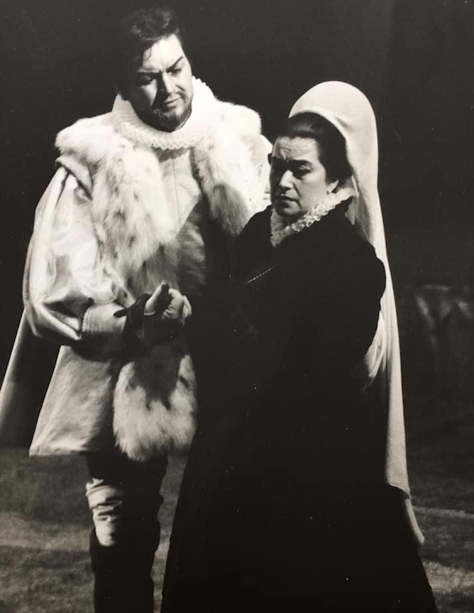
After Anna Bolena (sung in 1958 in Milan and Glyndebourne in 1965) and Elisabetta in Roberto Devereux (Naples ’64), the role of Maria Stuarda completes the Donizettian trilogy of British Queens sung by Leyla Gencer. Three very different characters which, however, have in common the Elizabethan era in England, the court settings, political and amorous vicissitudes all set around personage of great femininity.
Leyla Gencer performed Maria Stuarda at the Maggio Fiorentino, after the great success of Alceste in the same theatre a year before. Maria Stuarda opened the opera season at the Maggio Fiorentino and the company included Giorgio de Lullo (stage director), Pie Luigi Pizzi (scenery and costumes) and Molinari-Pradelli as conductor who successfully brought out the instrumental freshness and forceful passages of Donizetti’s music.
Preparations began with Leyla Gencer’s avid studies into the character to be portrayed by her; reading and studying not only Schiller’s play but also the biographies by Brysson Morrison (Mary Stuarda) and Stephan Zweig. As during the rehearsals of Alceste, an atmosphere of intense pervaded the “team” with Gencer being guided by the talent of De Lullo and Pizzi.
The result of the preparations was a very modern version of the opera: “the sites” of the play re used as symbolic images; the stage is fairly bare with predominantly grey and black colouring and lighting that “cuts” into the space and isolates the characters. Fothringay Forest, where the Queens meet, was Pizzi’s idea: three tree trunks in perspective, one carved into the shape of a seat, a footbridge were all that set the scene, and a wide, open space where the prisoner runs into; the prison scene is also colours are grey and black, forming shadows and dark areas, lighting only that part of the stage where the Queen stands. The characters are dressed in symbolic colours: Elizabeth in white silk embroidered with gold threads in Act I; for the scene in the forest she wears fox fur and purple feathers for the execution scene. Maria Stuarda, on the other hand, is dressed in dark colours – midnight blue and black. “De Lullo portrayed these two historical characters clearly.
“The show was a great success, but I don’t think that De Lullo’s invaluable and ingenious direction was quite fully appreciated at the time.” comments Gencer. “It is the second great step forward in our time as far as the interpretation of the Donizettian opera is concerned. The first step was made by Visconti – Callas in “Anna Bolena” where Visconti concentrated first and foremost on presenting the characters and then around them built the settings and atmospheres. In “Maria Stuarda, De Lullo uses fade-ins and fade-outs with the purpose of making the chain of events clear. In act III, while Elizabeth sits sullenly on her throne, looking like a great ugly bird in her purple feathers (She must seem like and ugly bird said Giorgio) tormented and uncertain she finally decides Mary’s sentence to death, the figure Maria Stuarda appears at the back of the stage behind heavy tulle curtains dressed in blue with a black veil, and remains there, unmoving. Here she personalised Elisabeth’s obsession, her nightmare, and when Elisabeth eventually leaves the stage, Maria then becomes the actual person and moves forward onto the stage on the opening chords of the prison scene – all in perfect sequence – and an example of De Lullo’s very significant stage direction. The powerful presence of Shirley Verret sang the part of Elisabeth in Florence. “The first act is entirely Elisabeth’s and Stuarda only enters in the second act. In my usual and egocentric and arrogant way, that fist act just didn’t exist as far as I was concerned, I just forgot it.”, “Giorgio, when I enter in the first act …” and each time De Lullo would correct me: “It isn’t the first act, dear, it’s the second….” Verret’s arrival was full of pomp and splendour, and entering in a sedan chair carried by her pages and dressed in white. My costumes, on the other hand, were very simple, befitting the Queen prisoner. I wore an off-green redingote, with a parsian type hairstyle and small light green veil. Imploringly I cried: But Giorgio, it isn’t possible. At least let me have a fur collar…… But De Lullo was unmovable: No nothing more for you: a coat, gloves – and your hands in your pockets. On the May 2, 1967, the first night, there was an atmosphere of great excitement. In her room Leyla Gencer heard the thunderous applause for Verret at the end of the first act, and here her competitive streak came out. Wen Ms. Gencer appeared in the second act, rushing forwards into the stylised forest and moving towards the ray of light and hoped for freedom she was greatly striking in her austere green dress, gloves and grey veil fixed by a bonnet that softened her proud and also melancholy face. Recitative and cavatina dissolve the bel canto aria into a soft blend of images, colours and sighs and her voice reflects her emotions, nostalgic and tender. Here both situation and the character have to be presented: coming out into the fresh air after such a long time and letting reactions and emotions run free. Colours is fundamental – it must be bright because the feeling of freedom is linked / tied to life and hope. She is a complex character and nonetheless always surrounded by an aura of femininity. The aria O nube, che lieve is reminiscent of her happy childhood in France, and where a light and graceful voice is required that present the frail side of the character. There is just a tremor when the hunting fanfare is sounded (Qual suono!) and the voice colour hints at the possibility of a contrast. The moderato e fiero (Nella pace del mesto riposo) with its low, well timbred notes brings one back to reality and the fear of the confrontation with her rival Elisabeth, and is followed at mezza voce by “Da tutti abbandonata” Donizetti, unusually, breaks off the “Dialogo delle Regine” (as he himself called this piece) between the final Sestetto and Stretto so that from the strength of this episode the whole scene of their meeting is nearly brought together. The vocal and psychological counter position of both Elisabetta and Maria Stuarda reaches such a height that – as Donizetti wrote in one of his letters – stirred the first two singers Ms. Ronzi (Maria) and Ms. Del Sere (Elisabeth) up so much that during a rehearsal they almost came to blows! The luxuriant stature of Verret’s Elisabetta acts as a catalyst: Elisabetta replies rudely and full of irony to Maria’s tentative approaches (Morta al mondo) which gives Maria the opportunity to throw invectives at her using all that power so far repressed, sarcastic, leaving no room for reactions, scornful and furious. And ends (vil bastarda, del tuo pié!) with a powerfully dramatic finale. “I performed a recitative that, today, I would not advise anyone to do” – comments Gencer – “but something very violent an aggressive came out and was applauded midway bringing the duet to a peak”. More emaciated looking in her dark blue dress, a black shawl over her shoulders, Maria Sturada appears at the beginning of act III in prison, standing, isolated in a ray of light. It is the important scene and duet of the confession which requires fluidity of movement and co-ordination of a great variety of forms such as recitatives, at times regal and then melancholic, pauses for thought, difficult lyrical passages and dramatic pieces. With an unrestrained voice she begins (Ah! Dal cielo discende la tua voce!) followed by an obsessive crescendo (Talbot, Io vedi tu?) to a gentle legato, almost seductive (Quando di luce rosea .... amor mi fe colpevole m’apri l’abisso amor ....) The limpidity of the melody remains intact: the descending arpeggio are tearful and the high and light passage from G minor to G major (a typically Donizettian structure expressing great emotion) becomes the moment of sincerity and truth (Ombra adorate, ah! Placate). Confronted by the bass, Agostino Ferrini, and her prayer she exists from the scene and has just enough time to change into her red costume for the execution scene while the choir sings of the cruelty of the scaffold dissolving into the pathetic. We come to the last scene, dark, with just a few rays of light and the silvery reflections that come from the armour worn by the guards. Dressed in red, the Queen moves towards the centre of the stage, with a cross held up to her breast, surrounded by her maids, clad in black. “I was so immersed in the role of Catholic Queen destined to die that maids – the excellent chorus singers of the Florence choir – dissolved into tears during every performance that they could hardly sing”
The recitative expresses a feeling of resigned sadness (Deh, tu d’un umile, preghiera del suono) and the voice weaves in with the choir.; there is a “rapport” with the choir of reciprocal elegiac stimulation where the soprano’s voice maintains the note (here for eight lines), gaining great, irresistible strength. Lord Cecil and his guards’ approach with the sentence and Maria’s mood of resignation continues (Di un cor che more reca il perdono), the phrasing has great magnanimity portraying the monarch who is now looking beyond life (Sulla Bretagna, sulla sua vita favor celeste imploro). One’s thoughts are now centred on innocent blood (a theme dear to the arias and cabalettas, of English melodrama) , sacrificing oneself in order to cancel any guilty action. The Queen is now victorious over history, comforted by her religious faith, but nonetheless the romantic composer has not quite finished portraying the many different faces of the character nor reconstructing Schiller’s finale. The infallible love theme appears again as Maria recovers her “ancient” feminine charm expressed in a cabaletta where she takes her leave of Leicester (Ah, se un giorno da queste ritorte) followed by a tragic and theatrically amplified melody sung to the by-standers (E il mio sangue innocente versato) she walks upright and dignified to the scaffold, and as the curtain falls Maria Stuarda is silhouetted on the dark back-ground – a red blood stain on a dark piece of cloth.